




Nigeria | 21 October 2026 | Gaming Regulation, Legal Disputes & Platform Integrity
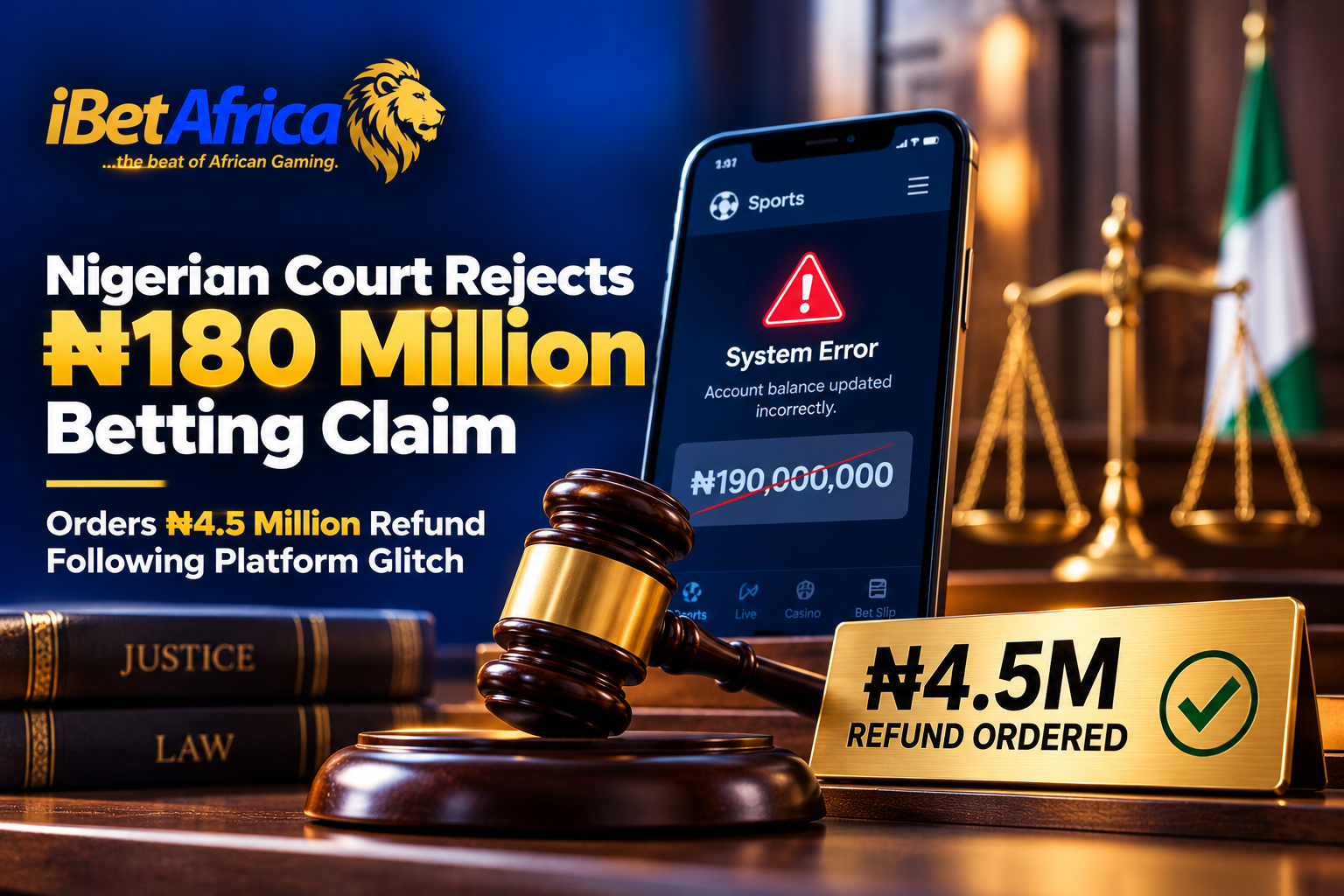
A Nigerian court has delivered a significant ruling in a dispute involving a sports betting platform malfunction, dismissing a bettor’s claim for more than ₦180 million in alleged winnings and ordering him to return ₦4.5 million previously withdrawn from his account.
The judgment, delivered by the Kogi State High Court in Lokoja on 14 October 2026, raises important questions about technology reliability, the treatment of erroneous account balances and the legal responsibilities of gaming operators and customers.
The case involved Isah Alih, whose betting account reportedly displayed an unusually large balance following a technical malfunction in September 2025.
How the Betting Platform Glitch Occurred
According to details reported from the proceedings, the dispute originated around 10 September 2025, when a technical fault affected a sports betting operator’s platform.
Instead of deducting funds during certain transactions, including bet placements and withdrawals, the system reportedly increased customers’ account balances.
The malfunction affected multiple accounts, generating balances that did not correspond to actual betting winnings.
Alih’s account was among those affected, with its displayed balance reportedly rising above ₦190 million.
Before the operator identified and corrected the malfunction, Alih withdrew approximately ₦4.5 million into his bank account.
After investigating the issue, the operator reversed the erroneous credits and restored affected balances.
Bettor Challenges Reversal in Court
Following the correction, Alih initiated legal proceedings against the betting operator.
He argued that the funds displayed in his account represented legitimate winnings and sought payment of more than ₦180 million.
His lawsuit also included claims for ₦100 million in general damages and ₦50 million in exemplary damages.
The operator disputed those claims, maintaining that the amounts resulted from a system error rather than successful bets.
It also filed a counterclaim seeking the return of the ₦4.5 million already withdrawn.
Court Rejects the Claim
In a judgment delivered on 14 October 2026, Justice Moses M. Gwatana of the Kogi State High Court dismissed Alih’s claims.
The court accepted the operator’s position that the disputed funds originated from a technical malfunction rather than genuine betting winnings.
It subsequently ordered Alih to refund the ₦4.5 million withdrawn during the incident.
The judgment also awarded ₦150,000 in general damages against the claimant and imposed post-judgment interest at an annual rate of 10% until the judgment sum is fully paid.
The ruling represents a consequential outcome for both parties, particularly given the difference between the amount originally claimed and the repayment ordered.
What Does This Mean for Betting Operators?
The dispute highlights the operational and legal risks associated with technology failures in digital betting systems.
Modern sportsbooks depend on interconnected systems responsible for wallet balances, bet placement, transaction processing, settlement and withdrawals.
An error affecting any of these processes can create financial discrepancies and disputes between operators and customers.
For betting operators, the case reinforces the importance of maintaining reliable transaction records, effective reconciliation procedures and clear processes for investigating technical incidents.
Operators also need transparent customer communication when account corrections become necessary.
Implications for Gaming Platform Providers and Aggregators
Although the dispute involved a betting operator and an individual customer, it also offers lessons for the wider B2B gaming ecosystem.
Platform developers, wallet infrastructure providers, payment partners and system integrator all contribute to the reliability of digital gaming operations.
A malfunction that incorrectly credits customer balances may expose weaknesses in transaction validation, accounting controls or the handling of unsuccessful transactions.
Regular system testing, transaction monitoring, audit trails and effective incident-response procedures can help reduce these risks.
The case also demonstrates why operators must understand the responsibilities of their technology partners when investigating financial discrepancies.
What About Player Protection?
The ruling should not be interpreted as giving betting operators unrestricted authority to cancel legitimate winnings.
Disputes involving account balances must be assessed according to their specific facts, applicable laws, contractual terms and supporting transaction records.
Customers should have access to understandable account histories and appropriate complaint-resolution procedures.
Likewise, operators must be able to distinguish between valid winnings and funds created by genuine technical errors.
Transparent handling of such disputes is essential to maintaining confidence in regulated betting markets.
A Wider Lesson for Africa’s iGaming Industry
As online betting continues expanding across Africa, the reliability of digital platforms is becoming increasingly important.
The Kogi State judgment illustrates how a technology malfunction can escalate into litigation involving substantial financial claims.
For operators, technology suppliers and regulators, the case provides an opportunity to examine transaction integrity, customer safeguards and dispute-resolution practices.
The central lesson is that strong gaming technology must be supported by equally strong financial controls, transparent records and accountable operational procedures.
As African gaming markets mature, these issues will remain central to protecting both operators and players.
iBetAfrica will continue monitoring developments involving gaming technology, legal disputes and player protection across African markets.
18+ | Gamble responsibly.