




Monrovia, Liberia | 28 October 2026
Liberia has introduced a comprehensive regulatory framework for its gambling industry, establishing new capital requirements, licensing fees and digital monitoring obligations for operators.
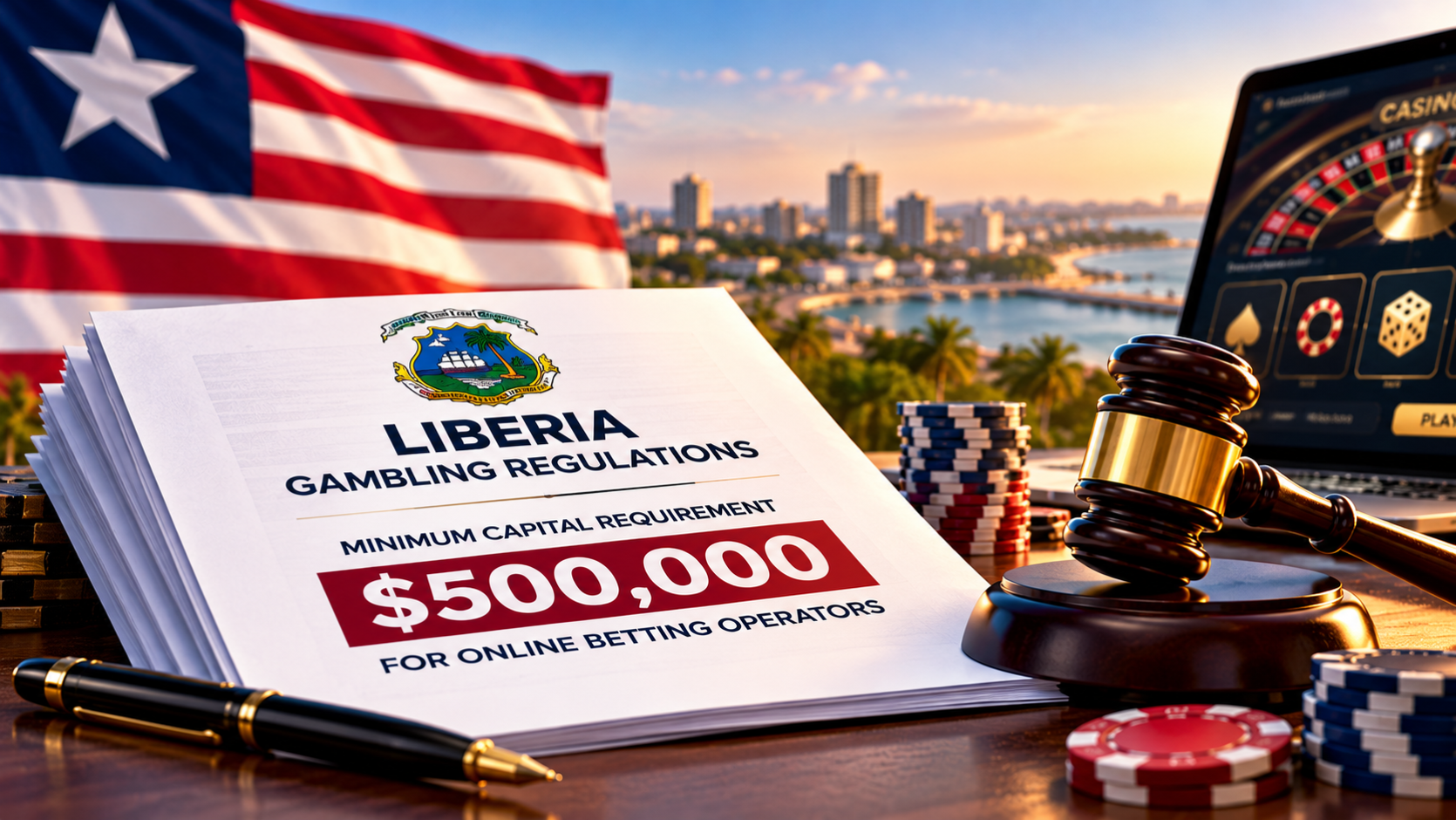
Under Regulation No. 005 of 2026, adopted by the National Lottery Authority (NLA), online casino and sports betting operators must maintain a minimum paid-up capital of US$500,000.
The reforms also introduce stricter requirements for gaming machines, cybersecurity, financial reporting and consumer protection, marking a significant shift in the country’s approach to regulating gambling activities.
New Capital Requirements for Gaming Operators
The framework establishes minimum financial thresholds for different categories of gambling businesses.
| Gaming category | Minimum paid-up capital |
|---|---|
| Casinos in Montserrado County | US$1,000,000 |
| Casinos in other counties | US$750,000 |
| Online casinos and sports betting | US$500,000 |
| Scratch-and-win operators | US$250,000 |
| Gaming machine operators (1–25 machines) | US$200,000 |
| Mini-slot operators | US$100,000 |
Existing licensed operators have 180 days from the regulation’s effective date to meet the new capital requirements, unless the NLA board specifies another transition period.
Operators must demonstrate financial compliance through audited financial statements and bank confirmation.
The required capital cannot be funded using player deposits or outstanding winnings.
Liberia Introduces Centralized Gaming Transaction Monitoring
A major component of the reform is the planned introduction of a Central Lottery Management System (CLMS).
The system will allow the NLA to monitor, audit and report gambling transactions conducted by licensed operators and approved partners in real time.
Once the platform becomes operational, operators will generally have 180 days to integrate their systems, unless a shorter period is prescribed.
After the transition period, licensed businesses will not be permitted to conduct gambling activities without the required connection.
This development could have significant implications for sportsbook technology providers, platform developers and payment infrastructure partners supporting the Liberian gaming industry.
Stronger Cybersecurity and Data Requirements
The regulation also strengthens technical compliance obligations.
Licensed operators must implement cybersecurity protections aligned with ISO/IEC 27001 or equivalent standards.
Significant cybersecurity incidents, data breaches and unauthorized interference affecting gaming operations or player information must be reported to the NLA within 24 hours.
Operators are also required to retain relevant financial, transactional, player-account and compliance records for at least five years.
These measures are intended to improve accountability, data security and regulatory visibility across Liberia’s gaming ecosystem.
Higher Licensing Fees and Tighter Machine Controls
The new framework introduces revised administrative and operational fees.
The annual licence fee for online casino operators is set at US$80,000, while physical scratch-and-win operators will also pay US$80,000, up from US$50,000.
The general gaming licence application fee has increased from US$400 to US$500, while late license-renewal fees have risen from US$500 to US$1,500.
The NLA has also strengthened its oversight of gaming machines.
Importation, sale, transfer, maintenance and disposal of gaming equipment will require appropriate regulatory authorization.
Machines must meet technical standards covering game integrity, payout accuracy and protection against tampering.
Specified gaming machine offences can attract fines starting at US$5,000.
Responsible Gaming and Community Development
Liberia’s reforms extend beyond financial and technical compliance.
The NLA has introduced additional measures addressing advertising, responsible gaming and the protection of vulnerable groups.
The framework also provides for a Good-Cause Levy of up to 1% of operators’ gross gaming revenue to support social and community development initiatives.
These provisions reflect the regulator’s intention to link gambling industry growth with stronger consumer safeguards and broader public benefits.
What This Means for Africa’s iGaming Industry
Liberia’s regulatory changes are particularly relevant to gaming operators considering expansion into West Africa.
The US$500,000 capital requirement introduces a substantial financial threshold for online betting businesses, while the annual licensing fees and technical obligations add to the cost of market entry.
For established operators, the reforms could encourage greater regulatory certainty and more consistent industry standards.
However, smaller gaming companies may face difficulties meeting the new financial and operational requirements.
The planned central monitoring system could also create opportunities for technology companies specializing in gaming compliance, transaction reporting, cybersecurity and regulatory integrations.
For payment service providers, the emphasis on transaction visibility reinforces the importance of reliable financial infrastructure and transparent payment reporting.
Conclusion
Liberia’s Regulation No. 005 of 2026 represents a significant development in the country’s gambling regulatory environment.
By introducing higher capital requirements, revised licensing fees, centralized transaction monitoring and stronger cybersecurity obligations, the National Lottery Authority is seeking to establish a more accountable and closely supervised gaming industry.
For operators, investors and technology providers, the reforms highlight the growing importance of financial readiness, regulatory compliance and local market understanding when expanding across Africa.
iBetAfrica will continue monitoring Liberia’s regulatory developments and their implications for the wider African gaming ecosystem.