






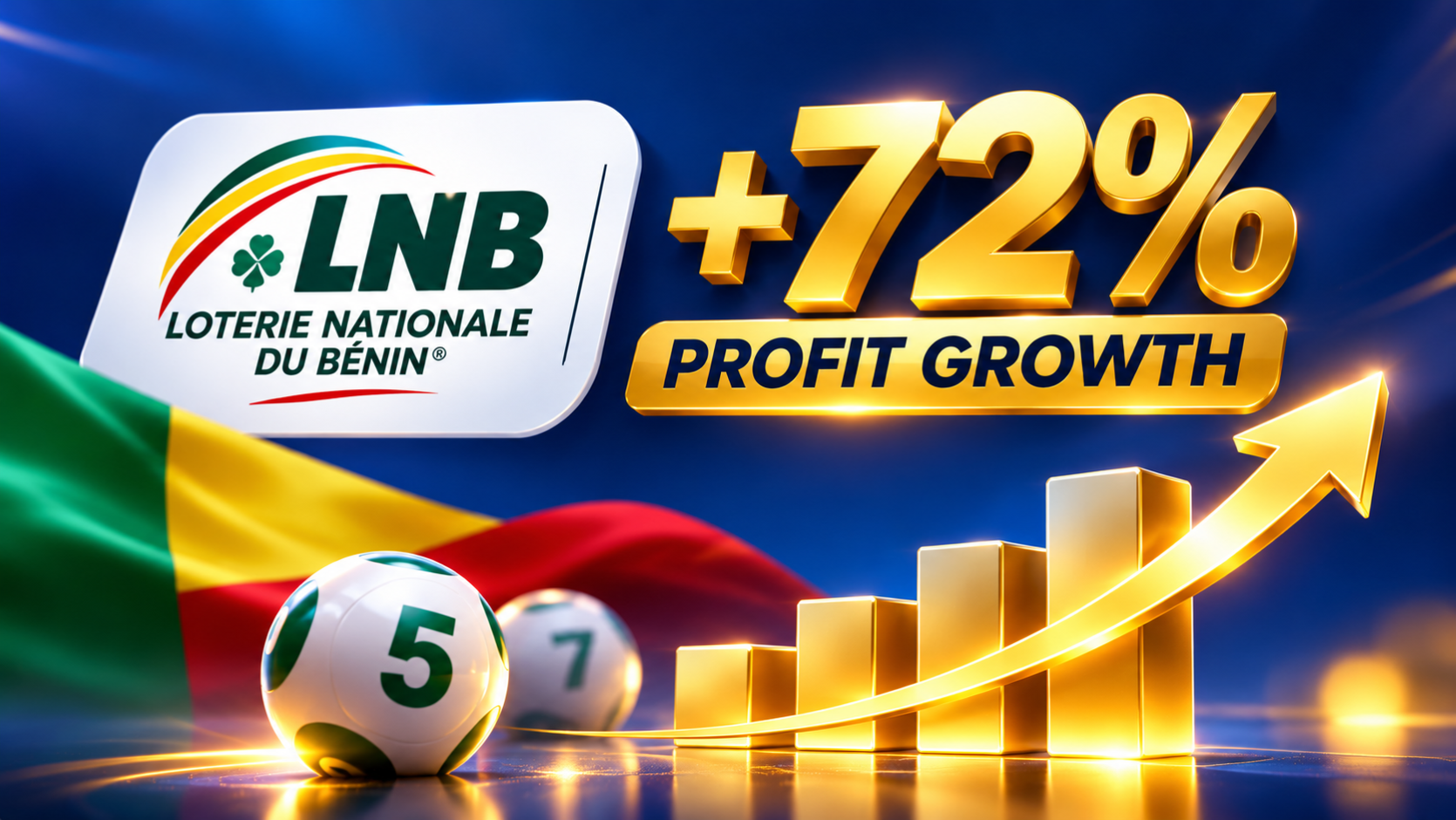
Benin’s national lottery operator, Loterie Nationale du Bénin (LNB), has reported a 72% increase in net profit for the first nine months of 2026, supported by stronger online betting sales and tighter operating cost controls, despite a decline in gross gaming revenue.
According to the company’s third-quarter financial report, dated 26 October 2026, net profit reached FCFA 1.778 billion, compared with FCFA 1.034 billion during the corresponding period in 2025.
The performance highlights the changing dynamics of Benin’s gaming market, where digital betting continues to gain momentum while traditional lottery products face increasing pressure.
Revenue Growth Driven by Online Betting
LNB recorded total revenue of FCFA 77.95 billion between January and September 2026, representing a 7.5% increase from FCFA 72.48 billion during the same period last year.
Online betting emerged as a major contributor to this growth, with sales increasing by 36.3%.
Digital betting products now account for approximately 48.4% of the company’s total revenue, demonstrating the growing importance of online gaming channels within its business.
However, the expansion of digital betting has not translated into an equivalent increase in gross gaming revenue.
Online betting contributes approximately 9.6% of the company’s gross gaming revenue, highlighting the difference between betting volumes and the revenue operators retain after paying player winnings.
Gross Gaming Revenue Falls Despite Higher Betting Activity
While total revenue increased, LNB’s gross gaming revenue declined by 9.7%, falling from FCFA 15.45 billion to FCFA 13.95 billion.
The decline was largely influenced by higher payouts to players.
Player winnings increased by 12.2% to FCFA 64.01 billion, compared with FCFA 57.03 billion during the corresponding period in 2025.
Consequently, the company’s return-to-player rate increased from 78.7% to 82.1%.
This means a greater proportion of betting revenue was returned to customers as winnings, reducing the amount retained by the operator before operating expenses.
The figures illustrate an important commercial reality for betting and lottery companies: increasing betting activity does not necessarily guarantee stronger gaming margins.
Traditional Lottery Sales Face Pressure
LNB’s report also revealed a significant decline in its traditional Loto 5/90 retail product.
Sales through physical outlets decreased by 22.3%, contributing to a FCFA 1.846 billion reduction in the product’s gross gaming revenue.
Despite the decline, physical Loto 5/90 remains an important part of the company’s portfolio, accounting for approximately 36.7% of total gross gaming revenue.
Growth in other products, including online Loto 5/90, partially offset the decline.
The changing performance of these products reflects the challenges facing traditional lottery operators as digital distribution becomes increasingly important.
For LNB, balancing physical retail operations with growing online betting demand will remain a central business consideration.
Cost Management Supports 72% Profit Increase
One of the most significant findings in the report is the role of operating cost reductions in improving profitability.
LNB reduced other net operating expenses by 16.5%, from FCFA 14.05 billion to FCFA 11.72 billion.
This represented savings of approximately FCFA 2.32 billion.
The reduction more than offset the decline in gross gaming revenue, helping operating profit increase by 58.5% to FCFA 2.22 billion.
Net profit subsequently rose to FCFA 1.778 billion, representing a 72% year-on-year increase.
The results demonstrate how effective cost management can improve financial performance even when gaming margins are under pressure.
LNB Plans Further Digital Expansion
Looking ahead to the final quarter of 2026, LNB intends to strengthen its commercial operations through a combination of retail expansion and digital customer acquisition.
The company’s priorities include extending its physical distribution network into areas with strong commercial potential and attracting additional customers through digital betting channels.
Management also plans to maintain strict operating cost controls to protect profitability.
These initiatives are intended to improve the contribution of individual gaming products while supporting sustainable business growth.
What This Means for Africa’s Gaming Industry
LNB’s financial performance provides valuable insight into the changing economics of African lottery and betting markets.
The growth of online betting demonstrates the increasing commercial importance of digital gaming channels.
However, the decline in gross gaming revenue also highlights the need for operators to examine profitability beyond headline betting volumes.
For gaming companies expanding across Africa, the results reinforce several important considerations.
Digital growth must be supported by sustainable product economics, effective operational management and a clear understanding of player payout structures.
Traditional retail gaming products also require careful management as consumer preferences evolve.
For technology suppliers and payment infrastructure providers, the increasing importance of digital betting may create opportunities to support operators with reliable platforms, transaction processing and operational efficiency.
Looking Ahead
Benin’s national lottery has demonstrated stronger profitability during the first nine months of 2026 despite challenging gaming margins.
Its next challenge will be translating continued digital betting growth into more sustainable gross gaming revenue while maintaining the cost discipline that supported its latest results.
For Africa’s gaming industry, LNB’s performance reinforces an important lesson: long-term profitability depends not only on increasing betting volumes, but also on managing costs, player payouts and the changing balance between digital and traditional gaming channels.