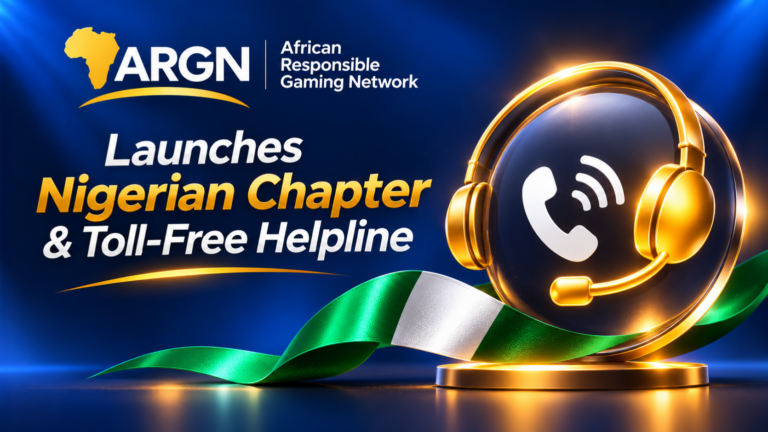





The African Responsible Gaming Network (ARGN) has announced the establishment of its Nigerian chapter alongside a national toll-free helpline, marking another step towards strengthening responsible gambling awareness and player protection in Africa’s largest population market.
Reported on 9 November 2026, the initiative aims to expand access to responsible gaming information, encourage safer gambling practices and strengthen support for individuals affected by gambling-related harm.
The development represents a country-specific expansion of ARGN’s work, bringing its advocacy and player-protection objectives closer to Nigerian communities.
ARGN Expands Its Presence in Nigeria
The launch of a Nigerian chapter is intended to establish a stronger local platform for responsible gaming advocacy.
Nigeria’s betting and gaming industry has experienced considerable development, supported by digital technology, mobile payments and growing consumer access to online entertainment.
However, the industry’s expansion has also increased the importance of responsible gambling education, player safeguards and accessible support services.
Through its Nigerian chapter, ARGN aims to contribute to these priorities by promoting awareness and encouraging collaboration among industry stakeholders.
The initiative also reflects the importance of adapting responsible gambling programmes to the circumstances of individual African markets.
Toll-Free Helpline to Support Responsible Gaming
A central feature of the announcement is the introduction of a national toll-free helpline intended to improve access to responsible gambling support.
Such services can provide an important point of contact for individuals seeking information about gambling-related risks or assistance in identifying appropriate support resources.
They can also help raise awareness of safer gambling practices and encourage people experiencing difficulties to seek help.
The precise helpline number, operating hours and scope of available services should be confirmed through ARGN’s official communication before being promoted to the public.
The initiative nevertheless highlights the growing recognition that responsible gambling requires accessible support mechanisms alongside regulation and operator-led safeguards.
Strengthening Responsible Gambling Awareness
Responsible gaming programmes seek to reduce gambling-related harm through education, early intervention and appropriate consumer-protection measures.
These measures can include age verification, self-exclusion arrangements, deposit and spending controls, responsible advertising and access to support services.
For Nigeria’s gaming ecosystem, greater public awareness of these protections can contribute to more informed participation in regulated gambling activities.
Independent advocacy organisations can also play a role in encouraging constructive dialogue between operators, regulators, communities and other stakeholders.
ARGN’s Nigerian chapter could provide an additional platform for these conversations.
Building on Africa-Wide Responsible Gaming Efforts
The Nigerian announcement follows ARGN’s broader activities promoting safer gambling across African markets.
The organisation’s previously reported Safer Gaming Month initiative brought attention to responsible gambling education, advertising practices and player protection across 11 African countries.
While that campaign focused on coordinated regional awareness, the Nigerian chapter represents a more locally focused initiative.
Establishing country-level structures may help responsible gaming organisations develop programmes that reflect local languages, cultural circumstances, regulatory environments and consumer needs.
This approach is particularly relevant in Africa, where gambling markets differ considerably in their operating structures and levels of consumer awareness.
What This Means for Nigeria’s Gaming Industry
For licensed betting operators and gaming technology providers, the development reinforces the importance of responsible gaming as part of sustainable industry growth.
Commercial expansion should be accompanied by appropriate measures to protect consumers and ensure that vulnerable individuals can access relevant information and assistance.
The initiative may also encourage greater engagement between gaming businesses and organisations specialising in responsible gambling education.
For regulators and policymakers, independent advocacy programmes can complement existing consumer-protection initiatives.
However, the establishment of the chapter should not be interpreted as introducing new regulatory requirements or enforcement powers.
Looking Ahead
The impact of ARGN’s Nigerian chapter will depend on the implementation of its programmes, the accessibility of its helpline and the partnerships it develops.
Further details about the organisation’s Nigerian leadership, public engagement activities and support arrangements will be important in assessing its progress.
For the wider African gaming industry, the initiative reinforces a central principle: responsible gambling should develop alongside market expansion.
As Africa’s gaming ecosystem grows, stronger player protection, public education and accessible support services will remain essential to building a sustainable industry.