






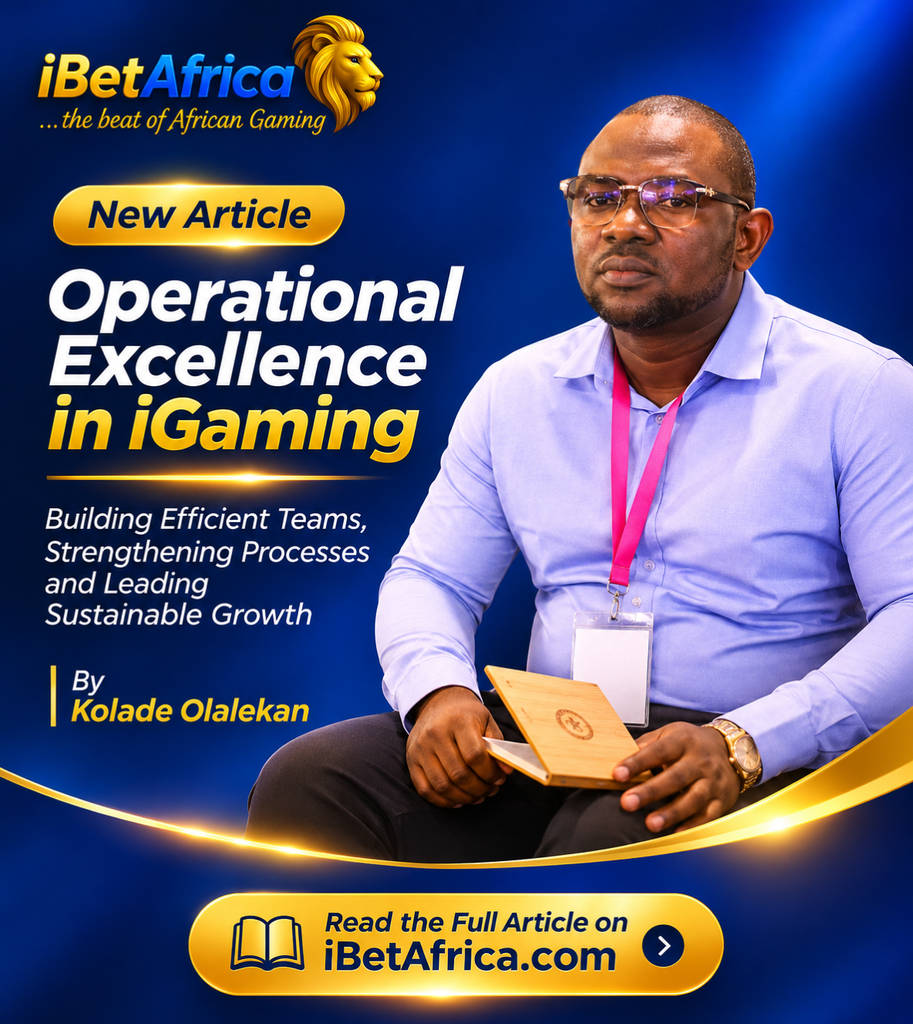
By Kolade Olalekan | iBetAfrica Industry Insights
In Africa’s evolving iGaming industry, attracting players is only one part of building a successful business. Behind every sustainable sportsbook or casino operation lies a combination of effective leadership, capable teams, reliable technology, efficient processes and a strong operational structure.
While marketing campaigns, player registrations and transaction volumes often dominate conversations about business growth, long-term success depends on an organisation’s ability to consistently deliver value, manage risks and adapt to changing market conditions.
Drawing from my experience across online sports betting, casino operations, retail gaming, business development and executive management, I have come to appreciate one important truth: a business can attract customers quickly, but without efficient operations and strong leadership, sustaining that growth becomes difficult.
Operational excellence is not a one-time achievement. It requires continuous improvement, clear accountability and a leadership culture that connects people, processes and technology to the organisation’s strategic objectives.
Here are ten essential principles for building efficient, resilient and sustainable iGaming operations.
1. Building Teams Around Business Objectives
One of the most important responsibilities of executive leadership is ensuring that the organisation has the right people in the right positions, with clearly defined responsibilities and measurable expectations.
In iGaming, departments such as Sportsbook Operations, Casino Management, Technology, Finance, Marketing, CRM, Customer Support, Compliance and Risk Management must work together.
When these departments operate in isolation, the business experiences delays, conflicting priorities, poor communication and missed opportunities.
An effective leadership structure should establish:
- Clear reporting lines and accountability.
- Defined roles, responsibilities and performance expectations.
- Measurable KPIs aligned with commercial objectives.
- Regular communication between departments.
- Continuous training and professional development.
- A culture that rewards performance, collaboration and responsibility.
However, building an efficient team goes beyond recruitment. It requires leadership that understands individual strengths, identifies capability gaps, delegates appropriately and empowers employees to make decisions within their areas of responsibility.
A high-performing organisation does not depend on one individual making every decision. It depends on capable people who understand their responsibilities, have the resources to deliver and are accountable for their results.
2. Improving Processes Before Expanding Operations
Expansion is often a major objective for iGaming businesses, particularly in competitive markets such as Nigeria.
Companies want to launch new products, enter new territories, increase their affiliate networks, open retail outlets and attract more customers.
However, expanding an inefficient operation only multiplies existing problems.
Before scaling, leadership must assess whether the organisation’s processes are effective, documented, repeatable and capable of supporting increased business activity.
For example, a sportsbook operator should regularly review its customer registration journey, KYC procedures, deposit and withdrawal processes, bet settlement, complaint resolution, promotional approvals and financial reconciliation.
Where retail operations are involved, processes for agent onboarding, shop openings, cash management, staff supervision, reporting and compliance must also be clearly established.
The objective is to eliminate unnecessary bottlenecks, reduce manual errors, improve turnaround times and create consistency across the business.
In my view, every critical operational process should answer three questions:
- Is the process necessary and effective?
- Can it be completed more efficiently without compromising control or customer experience?
- Can its performance be measured and improved?
When organisations continuously ask these questions, process improvement becomes part of their culture rather than a reaction to operational problems.
3. Technology and Platform Integration Must Serve the Business
Technology is at the heart of modern iGaming operations.
A sportsbook or casino platform must support a reliable customer experience, accurate transactions, effective reporting and seamless coordination between internal teams and external service providers.
Yet technology implementation should never be treated as a purely technical project.
A platform migration, payment gateway integration, CRM implementation or new product launch affects customer acquisition, retention, revenue, customer support, finance, compliance and overall business continuity.
Executive leadership must therefore ensure that every major technology project has clear business objectives, defined ownership, agreed timelines, appropriate testing and measurable acceptance criteria.
Before a platform goes live, the business should confirm that essential customer journeys have been tested, including registration, deposits, withdrawals, betting, settlements, bonuses, customer communications and reporting.
Payment channels deserve particular attention. Failed deposits, delayed withdrawals, unresolved reconciliation differences and poor transaction visibility can quickly undermine customer confidence.
A successful launch is not simply a platform going live. It is a platform operating reliably, supporting the business model and delivering the experience customers expect.
Technology should solve business problems, not create new operational dependencies.
4. Establishing a Performance-Driven Culture
Operational excellence requires measurable performance.
Without reliable data, management decisions can become based on assumptions, personal opinions or isolated incidents rather than the actual state of the business.
An effective executive team should establish a reporting framework that gives management visibility into operational performance, commercial outcomes, customer behaviour and emerging risks.
Depending on the business model and stage of growth, key indicators may include:
- Revenue, Gross Gaming Revenue (GGR), Net Gaming Revenue (NGR) and operating costs.
- New registrations, first-time depositors and active players.
- Deposit success rates and withdrawal turnaround times.
- Customer retention, reactivation and churn.
- Affiliate and marketing acquisition efficiency.
- Platform uptime, incidents and unresolved technical issues.
- Customer complaints and resolution times.
- Regulatory compliance, fraud exposure and responsible-gaming indicators.
The value of these metrics is not in producing reports alone. It lies in using them to identify problems, assign responsibility, make informed decisions and monitor corrective action.
For example, an increase in registrations without a corresponding increase in first-time deposits may indicate friction in the onboarding journey, weak acquisition quality, payment difficulties or a mismatch between marketing promises and the actual product experience.
Similarly, rising deposits accompanied by poor retention may suggest that the business is acquiring customers but failing to provide sufficient reasons for them to return.
The role of leadership is to look beyond the numbers and understand the operational factors influencing them.
5. Breaking Down Departmental Silos
One recurring challenge in growing organisations is the tendency for departments to focus exclusively on their own targets.
Marketing may prioritise registrations, Operations may focus on process completion, Finance may emphasise cost control and Technology may concentrate on delivery timelines.
Each department may appear productive while the overall business continues to struggle.
Executive leadership must connect these activities to a common set of business priorities.
Marketing campaigns should be coordinated with product readiness, payment capacity, customer support resources and promotional controls.
Finance should provide timely information that enables commercial teams to make sound decisions. Technology should understand the business impact of downtime, integration delays and unresolved defects.
Regular cross-functional meetings, shared KPIs, clear escalation procedures and transparent reporting can help departments work towards common outcomes.
The goal is not to eliminate departmental specialisation. It is to ensure that every department understands how its performance affects the wider organisation.
Business performance improves when departments stop operating as separate units and start functioning as one team.
6. Vendor Management and Strategic Partnerships
The success of an iGaming operator often depends on the performance of external partners, including sportsbook and casino platform providers, payment service providers, game suppliers, marketing agencies, technology vendors and other service partners.
However, outsourcing a service does not mean outsourcing accountability.
Executive leadership must ensure that vendors understand the organisation’s requirements, deliver against agreed service levels, communicate proactively and resolve issues within acceptable timelines.
Vendor relationships should be supported by documented responsibilities, clear commercial terms, defined escalation channels, performance reviews and contingency plans.
When a critical provider consistently fails to meet expectations, management must evaluate the commercial and operational impact, agree on corrective actions and determine whether the relationship remains sustainable.
Strong vendor management is particularly important during platform integrations and migrations, when delays or unresolved technical issues can affect deposits, withdrawals, customer trust and revenue.
The objective is to build partnerships that support business growth while protecting operational continuity and commercial interests.
7. Balancing Cost Efficiency with Customer Experience
Cost control is a fundamental management responsibility, but reducing expenditure without considering its operational consequences can be counterproductive.
Understaffing customer support, delaying essential technology improvements, cutting effective acquisition channels or reducing compliance resources may produce short-term savings while creating larger problems later.
A better approach is to evaluate expenditure against business value, operational risk and measurable outcomes.
Leadership should distinguish between costs that create strategic value and costs that can be reduced without harming the organisation’s ability to deliver.
In iGaming, customer experience is closely connected to operational execution.
Customers expect deposits to work, withdrawals to be processed transparently, bets to settle correctly, promotions to follow published terms and complaints to receive timely attention.
When these fundamentals are consistently delivered, the business creates a stronger foundation for trust, retention and long-term profitability.
Operational efficiency should mean achieving better outcomes with the resources available, not simply spending less.
8. Leadership During Growth, Change and Operational Challenges
Leadership is tested most clearly when the business faces uncertainty.
Platform migration, regulatory changes, aggressive competition, budget constraints, underperforming departments and unexpected operational disruptions all require timely decisions and effective coordination.
In these situations, executives must establish priorities, communicate clearly, allocate resources appropriately and maintain accountability without creating a culture of blame.
Effective leaders distinguish between individual performance issues, process weaknesses, resource constraints and failures in management oversight.
They ask what happened, why it happened, what the business impact is and what must change to prevent recurrence.
They also understand that accountability must be accompanied by authority and adequate resources.
Employees cannot reasonably be held responsible for outcomes when they lack the tools, information or decision-making power required to deliver them.
A strong leadership culture encourages people to raise concerns early, communicate risks honestly and focus on solutions.
This approach helps organisations become more resilient, responsive and capable of managing change.
9. Turning Strategy into Execution
A strategy has limited value if it remains a presentation or a series of management discussions.
Executive leadership must translate strategic priorities into actionable plans with defined owners, timelines, budgets, dependencies and measurable outcomes.
For an iGaming business preparing to launch or expand, this may involve a structured 30-, 60- and 90-day operational plan covering staffing, platform readiness, payment integrations, regulatory requirements, marketing execution, customer support, reporting and commercial performance.
Each workstream should have an accountable owner and a clear definition of completion.
Progress should be reviewed regularly, with delays and risks escalated before they affect the wider launch or business objectives.
Equally important, leadership must be willing to adjust plans when evidence shows that assumptions are incorrect.
Execution is not simply following a plan regardless of circumstances. It is maintaining strategic direction while responding intelligently to changing business conditions.
10. What Operational Excellence Should Ultimately Deliver
For me, operational excellence is the ability to build a business that performs consistently without depending on constant firefighting or the intervention of a single executive.
It means having capable teams, reliable systems, clear processes, meaningful performance indicators, strong controls and a leadership structure that supports sound decisions.
In practical terms, operational excellence should contribute to:
- Greater operational reliability and fewer avoidable disruptions.
- Improved productivity and clearer accountability.
- Better customer experience and retention.
- Stronger cost management and resource allocation.
- More effective risk management and regulatory compliance.
- Faster, evidence-based decision-making.
- A business model that can scale sustainably.
These outcomes do not happen overnight. They require discipline, consistency, investment and a willingness to challenge established ways of working when better alternatives are available.
Final Thoughts: Leadership Is About Building Systems That Work
My experience across different areas of the iGaming industry has reinforced my belief that sustainable business growth requires more than commercial ambition.
It requires operational discipline, capable people, reliable technology, effective processes and leadership that connects every part of the organisation to a shared objective.
A strong executive does not merely manage daily activities or respond to problems as they arise.
A strong executive builds the systems, teams and culture that enable the organisation to perform effectively, identify challenges early and improve continuously.
For iGaming operators looking to compete and grow in Nigeria and other emerging markets, operational excellence should not be treated as a back-office function.
It is a strategic advantage that directly influences customer trust, business resilience, profitability and long-term competitiveness.
My leadership philosophy is simple: build the right team, establish the right processes, measure what matters, take responsibility for outcomes and never stop improving.
Because in the end, the strength of an organisation is not measured only by how quickly it grows, but by how effectively it operates and how sustainably it delivers results.
About the Author
Kolade Olalekan is an iGaming industry professional with experience spanning online sports betting, casino operations, retail gaming, business development and executive management. His perspectives focus on operational efficiency, leadership, business performance and sustainable growth within the gaming industry.
Published by iBetAfrica — Connecting Africa’s Gaming Industry.