


Africa’s iGaming industry is growing rapidly, driven by mobile adoption, increasing internet access, and a young, digitally engaged population. Across key markets such as Nigeria, Kenya, and South Africa, operators continue to expand their reach and invest in user acquisition.
However, while many focus on traffic, marketing, and product offerings, one critical factor continues to determine long-term success — payment experience.
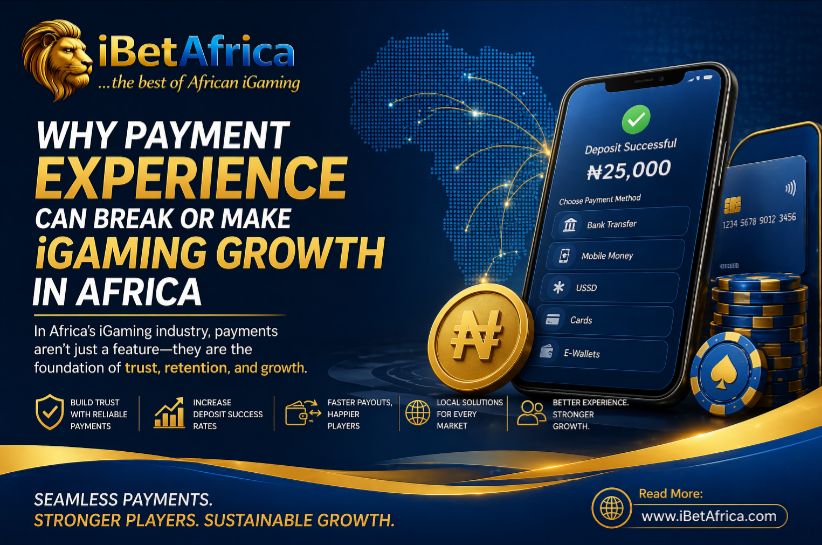
In Africa, payments are not just a feature. They are the foundation of user trust, retention, and revenue.
Payments as the Core of User Trust
For any iGaming platform, the user journey revolves around two key actions: deposits and withdrawals.
If a user cannot fund their account smoothly or access their winnings without delays, the entire experience breaks down. Unlike other digital products, iGaming platforms operate in a space where financial trust is non-negotiable.
In many African markets, users are highly sensitive to transaction reliability. A single failed deposit or delayed withdrawal can lead to immediate churn, regardless of how strong the platform’s offering may be.
As a result, payment experience directly influences how users perceive a brand, not just in terms of functionality, but credibility.
Fragmented Payment Infrastructure Across Markets
One of the biggest challenges operators face in Africa is the diversity of payment systems.
Unlike more unified markets, Africa consists of multiple countries, each with its own:
- preferred payment methods
- regulatory frameworks
- financial infrastructure
In East Africa, mobile money solutions such as M-Pesa dominate. In West Africa, bank transfers and fintech solutions like Paystack and Flutterwave are widely used. In Southern Africa, card payments remain more common.
This fragmentation means that operators cannot rely on a single payment strategy. Instead, they must integrate multiple local solutions to meet user expectations in each market.
Failure to do so creates friction, and friction leads to lost users.
Transaction Failures and Their Impact on Growth
Payment failure rates remain a major concern across the industry.
Issues such as:
- declined transactions
- network instability
- delayed processing times
- inconsistent payment gateways
can significantly affect conversion rates and user retention.
For operators, this translates into:
- lower deposit success rates
- reduced lifetime value of users
- increased customer support costs
More importantly, it damages brand trust in a market where reputation spreads quickly through word-of-mouth.
Withdrawal Experience as a Competitive Advantage
While deposits are important, withdrawals often define the user’s final perception of a platform.
In many cases, users are willing to try new platforms, but they remain loyal only to those that provide fast and reliable payouts.
Delays, hidden charges, or complicated withdrawal processes can quickly erode confidence. On the other hand, platforms that offer seamless withdrawals position themselves as trustworthy and user-focused.
In Africa’s competitive iGaming landscape, payout efficiency is no longer optional — it is a key differentiator.
The Role of Fintech in Solving Payment Challenges
Fintech companies are playing a critical role in improving payment experiences across the continent.
By providing localized payment solutions, better infrastructure, and improved transaction success rates, fintech partners enable operators to:
- reduce payment friction
- expand into new markets
- improve overall user experience
Strong partnerships between iGaming operators and fintech providers are increasingly becoming essential for growth.
These collaborations allow operators to adapt quickly to market-specific needs while maintaining operational efficiency.
Localization and Payment Preferences
Understanding local payment behaviour is another key factor.
Users in different regions have different expectations when it comes to:
- transaction speed
- payment methods
- currency options
Operators that tailor their payment systems to match these preferences are more likely to succeed.
Localization is not just about language or content, it extends deeply into how money moves within the platform.
Africa’s iGaming industry holds significant growth potential, but that growth will not be driven by marketing alone.
It will be driven by experience.
And at the center of that experience is payments.
Operators that invest in seamless, reliable, and localized payment systems will not only acquire users but retain them. Those that fail to do so will struggle to scale, regardless of their product strength.
In the African market, payment experience is not just part of the journey, it defines it.