





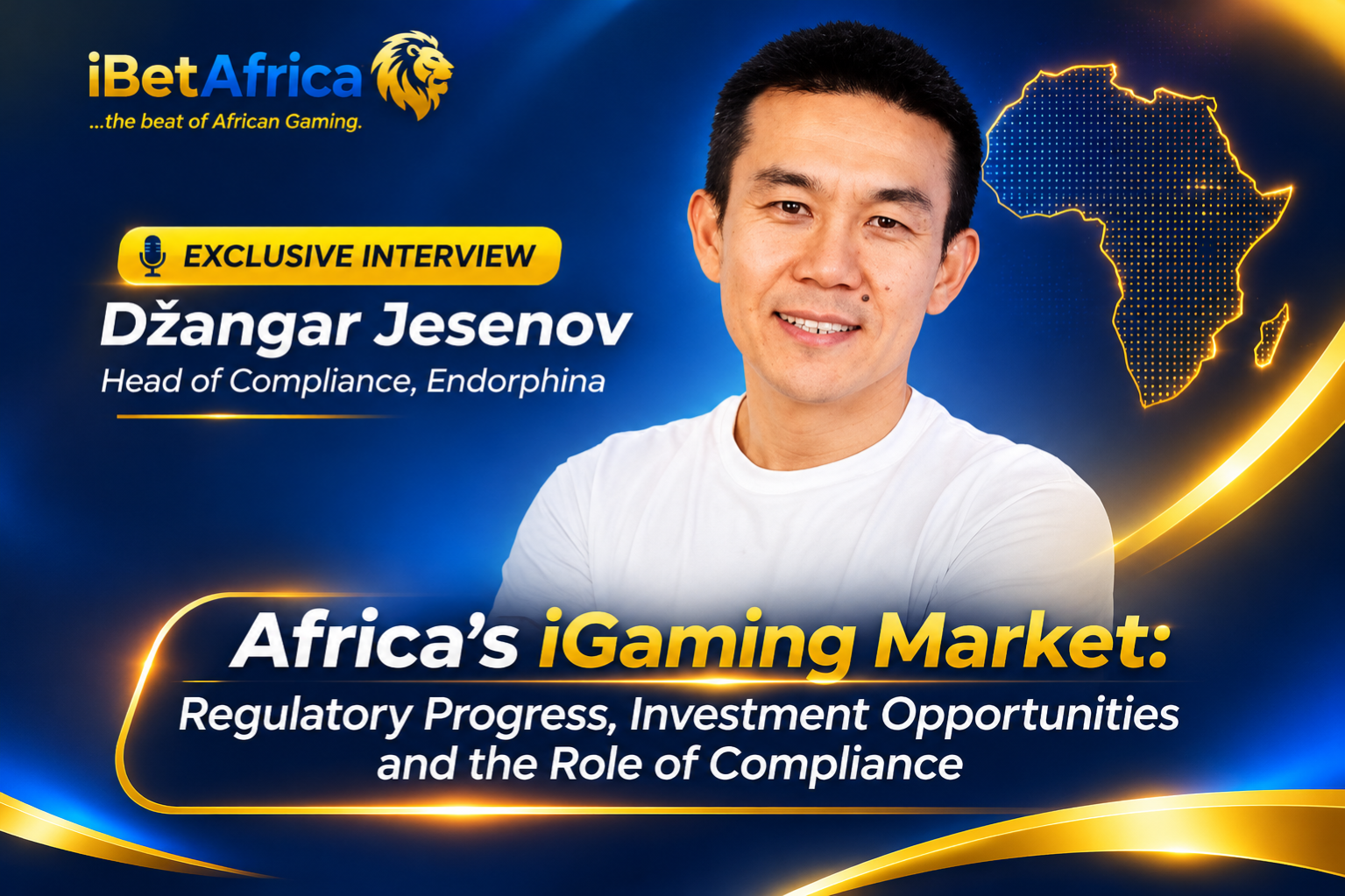
In an exclusive contribution to iBetAfrica, Džangar Jesenov, Head of Compliance at Endorphina, discusses Africa’s evolving gaming regulations, investment opportunities and why compliance is becoming central to sustainable market entry.
Africa’s iGaming industry is undergoing an important regulatory transformation, creating new opportunities for international operators, technology providers and investors prepared to approach the continent with a long-term compliance strategy.
That is the assessment of Džangar Jesenov, Head of Compliance at Endorphina, an international B2B online casino game provider.
Speaking to iBetAfrica about the development of regulated gaming markets across the continent, Jesenov highlighted improvements in regulatory transparency, licensing structures and institutional oversight.
However, he cautioned against approaching Africa as a single gaming market, emphasizing the importance of understanding the distinct legal and commercial requirements of individual jurisdictions.
An International Compliance Perspective
Jesenov is an international gaming compliance professional who reports having more than 15 years of experience in regulatory affairs, licensing and market-entry strategy.
During his five years with Endorphina, he says he has helped expand the company’s regulatory presence from nine markets to 59 jurisdictions.
His areas of expertise include gaming regulation, product certification, anti-money laundering and Know Your Customer requirements, information security and cooperation with gaming regulators, operators, independent testing laboratories and international business partners.
Endorphina confirmed its 59th regulated jurisdiction in August 2026 following approval to enter Alberta, Canada.
Africa’s Regulatory Transformation
iBetAfrica: How do you assess the current regulatory development and investment potential of Africa’s iGaming market?
Džangar Jesenov:
Africa’s gaming industry has achieved remarkable regulatory progress.
Although the continent cannot be approached as a single homogeneous market, a growing number of African jurisdictions now have transparent regulatory frameworks, identifiable authorities acting as market guarantors, clearly defined licensing requirements and established rules governing gambling activities.
This represents an important transition from legal uncertainty towards structured and accountable markets.
A regulator should not merely issue licences. It should protect players, supervise authorized participants, enforce applicable rules and provide investors with a predictable regulatory environment.
Why Africa Is Attracting Investment Interest
Africa’s investment potential is equally significant.
Its large and expanding working-age population, growing internet and mobile penetration, development of digital payments and improving economic indicators create substantial opportunities for companies prepared to invest capital, time and professional expertise.
However, success requires more than entering a market with a large population.
It requires the correct legal structure, local regulatory knowledge, suitable payment solutions, technical readiness and a long-term compliance strategy.
The speed of regulatory development is particularly impressive.
In several jurisdictions, regulatory frameworks are approaching the level of transparency and operational sophistication found in countries that have regulated gambling for decades.
Different models can be observed across South Africa, Ghana, Zimbabwe and Nigeria, although permitted products and licensing structures vary considerably between them.
Nigeria and Enugu State’s Regulatory Progress
Nigeria is especially interesting because of its increasingly important state-level regulatory frameworks.
From my perspective, Enugu State is a strong example of this development.
Its focus on regulatory modernization, digital licensing, operator verification and clearly defined local requirements demonstrates how a state regulator can create greater transparency and investor confidence.
Nevertheless, an Enugu license must be assessed within its proper territorial and legal scope. It should not automatically be presented as unrestricted authorization for the whole of Nigeria.
Compliance as the Foundation of Sustainable Growth
Africa should no longer be viewed as an unregulated frontier.
It is becoming a diverse collection of increasingly structured gaming markets.
The strongest opportunities will belong to investors who treat compliance not as an administrative cost, but as the essential infrastructure of sustainable growth.
iBetAfrica’s Perspective
Jesenov’s assessment highlights an important consideration for international gaming companies evaluating opportunities across Africa.
Market size, customer demand and technological accessibility are important commercial factors, but they do not replace the need for jurisdiction-specific regulatory analysis.
For gaming operators, B2B platform providers, casino game suppliers and payment companies, understanding licensing requirements, compliance obligations and local market structures remains essential.
His perspective also underscores the growing importance of regulatory institutions in creating predictable environments for responsible investment.
As African gaming markets continue to develop, cooperation between regulators and industry stakeholders could play an increasingly important role in supporting legitimate business growth and player protection.
The central message is clear: Africa’s gaming opportunities are expanding, but sustainable market entry begins with regulatory understanding and compliance.
About the Interviewee
Džangar Jesenov is Head of Compliance at Endorphina, an international B2B online casino game provider. His professional work covers gaming regulation, licensing, product certification, AML/KYC, information security and international regulatory cooperation.
This article forms part of iBetAfrica’s industry interview series, featuring perspectives from professionals shaping the global gaming ecosystem.
The views expressed by the interviewee are his professional assessments and do not constitute legal advice or an announcement of Endorphina’s entry into any specific African market.